This post almost broke my blog.
I’ll confess, I’ve long since run out of prewritten content, so now this site just idles between updates. Looking back, I could have bought myself some time by publishing my earlier stuff at a slower rate, but I thought my blog would gain more traction if I appeared to be a frequent poster.
Algorithms are fickle things, though—so fickle, in fact, that I actually got more traffic after months of inactivity than I did during some periods when I was trying to steer people here. My dive into Curly Howard’s proto-moonwalk appears to be the most favored by search engines (probably because it doesn’t contain swearing, trash talk about AI, or summaries of movie scenes involving graphic human dismemberment).
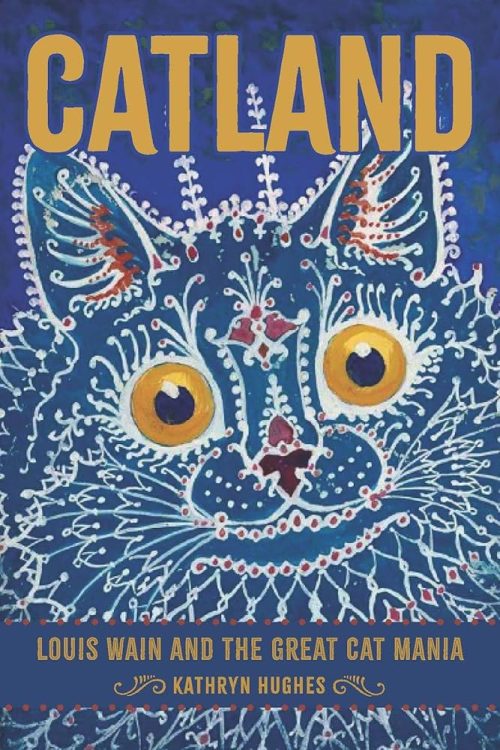
But I digress. It’s time to discuss the biography of Louis Wain that took 7 years for the author to research, and what felt like 7 years for me to read.
I love cats and I love art. I should have loved Catland.
Why, then, did I struggle so monumentally just to finish it?
For one, the book frequently veers away from Wain’s life and works in favor of decidedly niche topics, such as the history of textiles in 19th century Britain and France. While author Kathryn Hughes manages to weave in a far more engaging narrative about the origins of cat shows and breeding, it ultimately feels like Catland tries to be too many things at once—and I say that as someone who usually enjoys works that defy categorization.
When the historical asides aren’t mind-numbing, they occasionally become weirdly grotesque. I feel obligated to warn my fellow feline fanciers that Catland contains numerous descriptions of real-life violence against cats, to the point where some cat haters might find their reading experience more satisfactory than many cat lovers would. There’s nothing inherently wrong with tackling this subject matter, but such commentary occupies way too much of a book whose back cover blurb proclaims it, “A perfect gift for cat lovers, art lovers, and readers of all persuasions.”
Portions of Catland also border on thesaurus vomit. After 50ish pages, I started to write down unfamiliar vocabulary whose meanings I couldn’t easily glean from surrounding passages. By the time I skimmed my way through the acknowledgements, I had compiled a list of 70 terms.
Admittedly, some may have just been Britishisms, but others were Greek to me—and by Greek, I mostly mean French. What sorts of subtleties necessitated the use of “recherché” instead of “rare,” or “manqué” instead of “wannabe”? Je ne sais quoi.
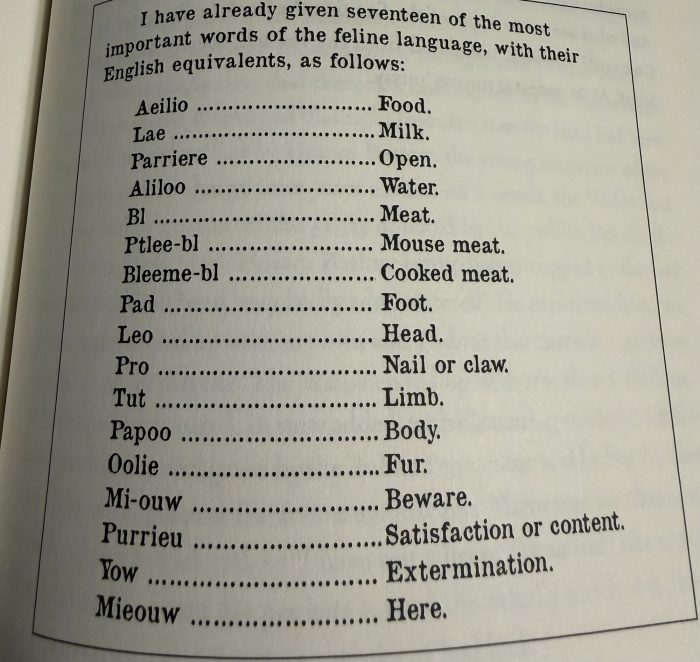
Look, I know I inundate my own readers with some nerdy-ass words, not to mention all the puns, portmanteaus, and parentheticals. But I usually define more obscure terms both outright and through context clues, and I at least try to make my tangents funny.
Catland certainly has its merits, including fascinating glimpses of the late Victorian and Edwardian culture that influenced Louis Wain, as well as beautiful color prints of his paintings. In the end, though, I mostly stuck with it to prove to myself that I still had the focus to get through an entire book. It’s something I don’t want to take for granted in a climate that encourages excessive scrolling through short-form content.
At least, that was my excuse for forcing myself to keep reading Catland, until I breezed through two novels (The Family Izquierdo and The Long Walk) while I was still stuck somewhere between vaguely cat-themed anecdotes about stuffy aristocrats and depressing accounts of how people used to dispose of unwanted kittens. Then I guess my goal became getting through a nonfiction book. Or maybe I’m just a completionist, and I let the sunk cost mess with my head.
Catland is hardly the first book I’ve had trouble finishing. When I had to read Light in August for one of my college classes, my mom let me borrow her copy. I immediately noticed a built-in ribbon bookmark stuck about one-third through; it had been there long enough to bleed into the page. My mother, who’d perused entire epics such as War and Peace, had evidently given up on this much shorter William Faulkner novel. After slogging through Light in August for myself, I came to understand why.
Faulkner is a master at creating vivid and intriguing prose, then weaving it deftly into meandering paragraphs of Southern fried verbosity peppered with casual racism.(I can appreciate that the author was a product of his time, but was it necessary for the otherwise-mostly-objective omniscient narrator to refer to the collective descendants of enslaved people as “lazy”?) His writing is as dense as Ernest Hemingway’s is accessible, and readers have to push past a lot of rambling to get to the meat of the story.
Nevertheless, there is a story—a pretty gnarly one, even. I did feel a sense of accomplishment staying along for the ride, both when I made it past the point where my mom tapped out, then again when I finally reached the surprisingly optimistic ending.
Sometimes the delayed gratification of literature is very delayed. The summer before my freshman year of high school, my dad signed me up for a speed reading class in the hopes of improving my academic time management. It…didn’t really help on that front, but it did give me tools to hone my cramming skills. Among other things, my classmates and I learned a technique called long smooth underlining (LSU for short).
Our practice text was The Fellowship of the Ring, but we only got as far as Frodo’s confrontation with the Ringwraiths at the Ford of Bruinen. Having greatly enjoyed Peter Jackson’s film adaptation, I decided to finish it on my own, but that turned out to be more of a challenge than anticipated.
In the movie, the Council of Elrond is simultaneously a gathering of momentous weight and a veritable fountain of memes. Even if you know nothing about The Lord of the Rings, you’ve probably seen an image macro of Sean Bean as Boromir with text riffing on the phrase “One does not simply walk into Mordor.”

The scene manages to introduce him and the other remaining Fellowship members in quick succession, giving us glimpses of their personalities with just a few very memorable lines. It’s both suitably epic and full of enough levity to ease the audience into the darkness that follows.
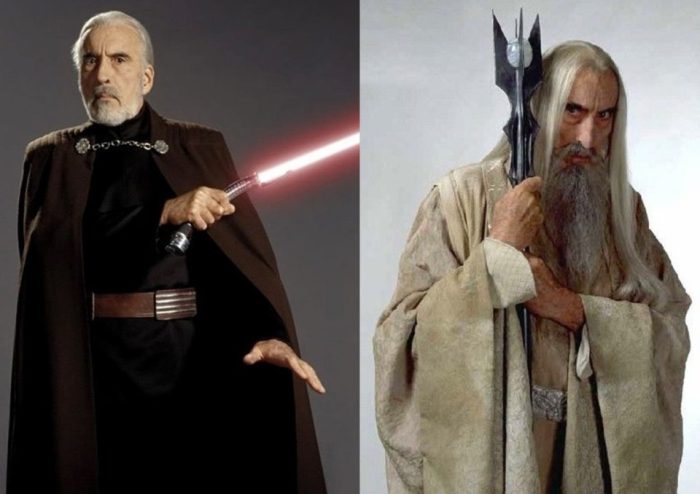
In the book, the Council of Elrond is when the entire plot comes to a screeching halt as Gandalf gives an incredibly long-winded exposition dump. I couldn’t believe how many words it took just for him to say, “Saruman’s turned bad.” (And really, why was that a surprise? The guy became a Sith Lord!)
I found the chapter so tedious that I ended up putting down the book for an entire year. I’m glad I returned to it, though; once I got past those pages, the pace picked back up. The end of the book was genuinely thrilling, even though I knew what was going to happen.
I haven’t reread the LOTR trilogy in quite some time, so I’m not sure if the Council of Elrond chapter is as dull as I remember. It can’t possibly be slower than Catland, though. Or can it?
Truthfully, I don’t know what I’ll do next time I feel trapped in a self-imposed reading assignment. On the one hand, life is short, and I’d prefer to engage with books that don’t feel like chores. On the other hand, if I don’t challenge my brain to endure moments of boredom in exchange for a decent payoff, I worry what that will do to my already-dwindling attention span. If Catland has taught me anything, though, it’s that not every book has a payoff.
There is so much of the English-language literary canon that I’ve never gotten around to reading, or didn’t fully appreciate when I was younger. I’m long overdue to crack open a George Orwell novel; somehow, I went through both high school and college without encountering Animal Farm or 1984. And I could probably benefit from a more careful and mature rereading of The Great Gatsby.
I’ve even debated whether to tackle the doorstopper Infinite Jest for the sole purpose of understanding the various references to it in the Decemberists’ “Calamity Song” music video. If that turns out to be more effort than it’s worth—well, nobody’s making me stick with it.
But if you’ve chosen to stick with this post, and my blog in general, I appreciate the support. My reading and writing journeys are heavily intertwined, and I’m eager to see where they lead.


 Media Shower