In early May, I finally got around to using the “Lusty Lavender” hair color kit I bought more than a decade ago. I had delayed this process for a number of reasons, including awkward living situations (I wasn’t about to attempt a dye job in a communal dorm bathroom), general tiredness, and simply forgetting about it.
Admittedly, I was also trying to avoid misrepresenting myself; I didn’t want to look like a Manic Pixie Dream Girl, only to disappoint everyone by being more of a Depressed Vulcan Nightmare Woman. At this stage, though, I’m secure enough in my identity to take the plunge.
I was going for a particular shade—think “Smoke on the Water” band—but ended up with a multicolored sunset-looking blend that’s honestly not the worst thing ever. The only part of my head that resembles the color on the box is…well, my part.
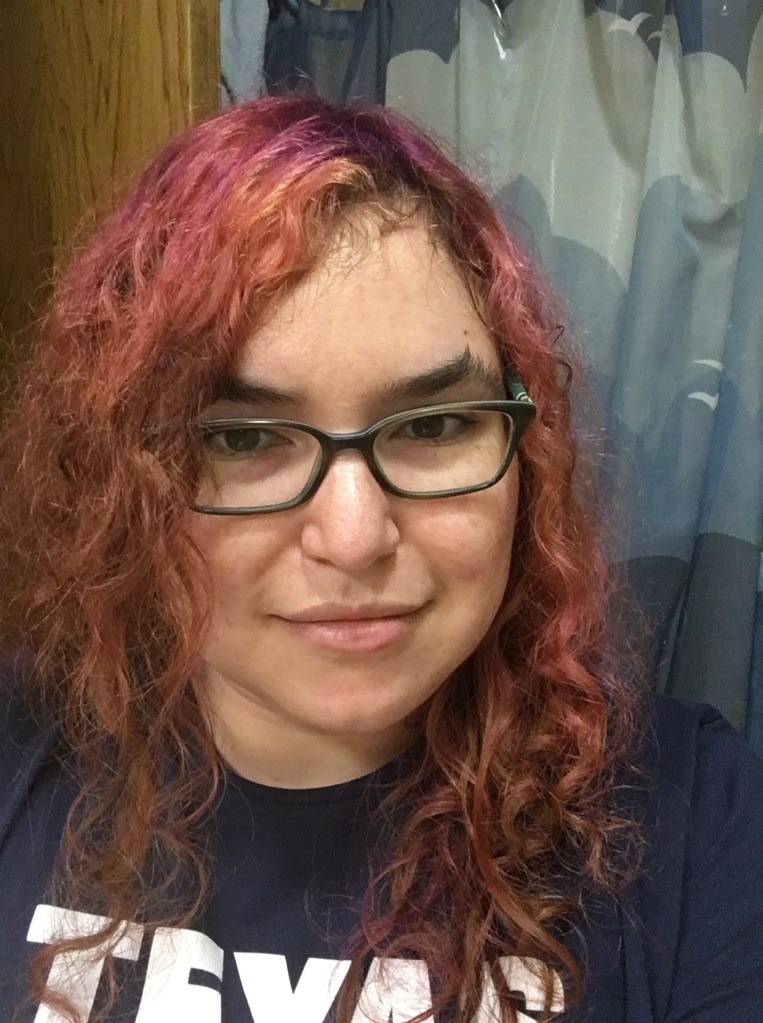
In all fairness, the instructions did warn me to keep the dye off my scalp. But because I basically have Larry’s hair from the Three Stooges (thick and curly around the sides, much thinner on top), any product I put in that vicinity WILL end up on my scalp, period. I’m sure there are professional methods for circumventing this issue; my strengths simply lie in other pursuits, like overanalyzing punctuation and taking the piss out of TV ads.
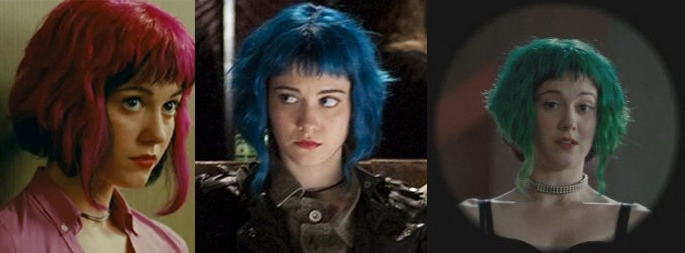
Naturally, the whole experience got me thinking about cinematic portrayals of female characters with brightly colored hair. The first to come to mind was Scott Pilgrim vs. the World’s Ramona Flowers, who’s arguably a deconstruction of the MPDG trope. Sure, she’s a quirky young woman who enchants the hero and changes her hair as frequently as she changes clothes, but her demeanor is quite mellow—hardly what anyone would call “manic.” Ramona’s not the only one to sport chromatic tresses, either; Knives Chau briefly rocks some cool highlights, until she gets them punched out of her hair.
For some reason, I also thought of Léa Seydoux’s character from Blue is the Warmest Color, even though I had never seen that movie. I’d heard a lot of buzz about it back in the day, though, and it had long sat on my to-watch list. I decided to rectify that.
Besides fully earning its NC-17 rating, Blue is the Warmest Color provides enough material to sustain multiple weeks of a film studies course. Its original French title is La vie d’Adèle, and with good reason—the unkempt brunette heroine (Adèle) doesn’t properly meet the blue-haired woman of her dreams (Emma) until about 45 minutes into a 3-hour movie. But in a reversal of stereotypes, Adèle is the one who actually functions as an artistic muse for Emma.

Like Ramona Flowers, Emma has a rather laid-back personality—at least initially. As she becomes less of a fantasy and settles into a life of boring domesticity, Emma’s distinctive color fades. She never reapplies it. Her hair is a striking visual representation of how even the most passionate relationships crumble without constant upkeep.
A good movie can obviously flesh out any character regardless of their appearance, but is the nonconformist chick with vibrant locks ever not the object of the protagonist’s desire? Well, what if she is the protagonist?
The titular Lady Bird might be the straightest example of a Manic Pixie Dream Girl from 2010s cinema, both figuratively and literally (though I would absolutely support a sapphic interpretation of some of her moments with Julie). Saoirse Ronan’s character is loud, mercurial, and a bit of a pathological liar. However, her starring role gives the audience an inside look at someone who would normally be the eccentric love interest in another person’s story—and boy, is it a miserable existence. She only seems to find peace when she stops trying so hard to project a curated self-image, which includes abandoning the Lady Bird moniker in favor of her birth name, Christine.
Of course, big-screen queens with colorfully dyed hair long predate these examples. Run Lola Run, an experimental German film that may have influenced some of Scott Pilgrim’s stylistic idiosyncrasies, was released in 1998. Lola herself is a superhero in all but name, and far too dynamic to be boxed into a single archetype. Despite what the title would have you believe, her powers are sound-based, not speed-based—Lola’s screams can shatter glass and possibly manipulate time.

In this world and the worlds of these films, hair dye is just one of many tools people use to express themselves. Women and girls in particular already have their looks heavily scrutinized, so why not go wild with genetically impossible colors? I don’t know what’s next for my rat’s nest, but one thing is certain: I’m not too old to dye young.

 Media Shower