
Enjoying older media often entails accepting outdated terminology, politically incorrect humor, and plain wrong notions about our fellow humans. But every once in a while, a surprisingly inoffensive hidden gem will surface from the vault of our complex history.
The Alfred Hitchcock Hour was a continuation of the anthology series Alfred Hitchcock Presents that doubled the episode length (for better or worse). Like its more famous yet shorter-lived contemporary, The Twilight Zone, the show ranged from the speculative and supernatural to the more grounded. And, as with The Twilight Zone, it has since spent decades in syndication on cable channels, usually at late hours.
One Hitchcock episode examines the consequences of overcrowding in certain Mexican cemeteries—namely, if families of the deceased couldn’t keep up with burial plot rental payments, their loved ones would be exhumed to make room for other bodies. This was an actual thing that happened, and author Ray Bradbury’s horror at the situation inspired at least two stories: 1947’s “The Next in Line,” about an American couple stranded near the catacombs of Guanajuato, and 1963’s “The Life Work of Juan Diaz,” which Bradbury himself adapted into a teleplay in 1964.
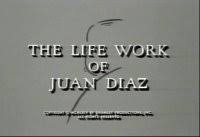
Spanning a year between two Days of the Dead in Mexico, “The Life Work of Juan Diaz” concerns the titular character’s preemptive rental of his own gravesite, the creepy cemetery caretaker’s attempt to cheat Juan’s eventual widow Maria out of more money, and Maria’s efforts to make the best out of her family’s predicament.
My dad and I stumbled upon this episode at midnight on MeTV during the pandemic. It’s important to note that until fairly recently, Día de los Muertos was often portrayed in U.S. media as a “Mexican Halloween,” with little or no emphasis on commemorating deceased loved ones. When the two of us realized when and where “The Life Work of Juan Diaz” was set, we prepared to cringe. We thought the festivities would be reduced to dime-store skeletons and mangled Spanish. We figured at least some of the actors would don brownface. Still, curiosity kept us watching.
Against all expectations, the Day of the Dead was treated with respect. The Mexican characters were not flat stereotypes. And in a rarity even for modern productions, let alone ‘60s shows, the cast consisted predominantly of Latino and/or Hispanic actors.
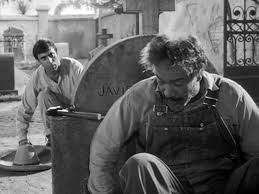
My dad and I were so caught off guard by the episode’s cultural sensitivity that we instantly agreed it was something we needed to watch again to fully appreciate. We also decided to show it to my mom if we got the chance.
We only had to wait a few months before MeTV cycled back to that episode, and this time, we made sure my mom got to see it, too. It was well worth a rewatch; now that we weren’t bracing ourselves for embarrassing moments, we could focus on the story’s macabre beauty, poignancy, and understated humor.
Much of the episode’s pathos stemmed from 30-year-old Pina Pellicer, an accomplished Mexican-born performer who had starred opposite Marlon Brando in the 1961 western One-Eyed Jacks. Although the episode was named for Juan Diaz, she played the true protagonist, and was utterly mesmerizing as a resilient widow whose creative problem solving allows her to honor her husband and support her children at the same time.
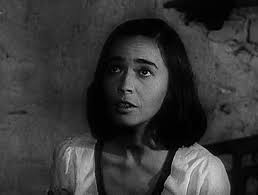
Tragically, Pellicer would take her own life shortly after the episode’s debut. While the world lost her far too soon, I’m glad “The Life Work of Juan Diaz” exists as a showcase of her talent.
If you don’t have a slew of cable channels that play oldies, you can currently stream this and other Hitchcock episodes on Roku and Peacock.

 Media Shower