
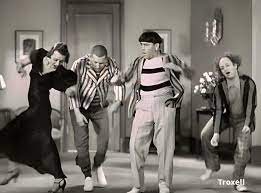
Harry, Hermione, and Ron. Kirk, Spock, and McCoy. Alvin, Simon, and Theodore. Few trios are as iconic as Moe, Larry, and Curly—and even fewer have a third member so beloved it’s easy to forget they weren’t part of the original line-up.
Jerome Lester Horwitz, better known as Curly Howard, joined the Three Stooges in 1932 as a favor to his brother Moses (Moe), replacing his other brother Samuel (Shemp). Little did any of them know just how rapidly Curly would eclipse Shemp in the popular consciousness. His impressive athleticism, combined with his goofy vocalizations, elevated much of the act’s oeuvre from mere silliness to comedic gold. And, as some modern viewers have noticed, at least one of Curly’s signature moves may have contributed to the evolution of dance as a whole.
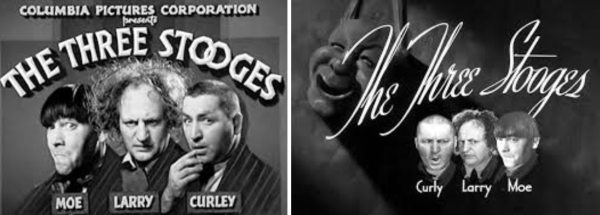
My dad and I had been making our way through the Columbia Pictures Three Stooges shorts, in chronological order. As expected, some moments aged poorly—the minstrel show tropes and depictions of American Indians were particularly cringeworthy—but for the most part, the films punched up rather than down, and their class commentary held up quite well. Some elements were even ahead of their time; the proudly Jewish Stooges famously made fun of Hitler in You Nazty Spy! months before Charlie Chaplin’s turn in The Great Dictator. So perhaps it shouldn’t have surprised us when we spotted what appeared to be a dance move that only became mainstream nearly half a century after the Stooges’ heyday.
I don’t remember exactly which short we were watching, but during one of his bits, Curly suddenly performed a backward foot slide as his upper body leaned forward. After a beat, my dad turned to me and asked, “Did Curly just do the moonwalk?”
As far as either of us knew, the moonwalk had originated during the ‘80s, courtesy of Michael Jackson. Could it be that a pioneer of slapstick comedy inspired a serious dance phenomenon?
A cursory Google search confirmed the King of Pop was a huge fan of the Three Stooges and especially Curly. In fact, Jackson wrote the foreword to Joan Howard Maurer’s book on her late uncle, Curly: An Illustrated Biography of the Superstooge. Admittedly, this evidence is mostly “soikemstanshul,” as the man himself might say, but a number of Stooge enthusiasts (enstoogiasts?) have made the same connection.
Curly and MJ had a surprising amount in common. Both were skilled dancers, of course. Both rose to meteoric fame while performing with (and stealing the spotlight from) their brothers. And both died prematurely—Curly at 48 after complications from several strokes, and MJ at 50 of an overdose for which his doctor was found at fault.
The history of the moonwalk itself includes many possible points of origin, but in any case, it’s much older than I’d previously thought. Wikipedia’s article on the moonwalk makes no mention of Curly, but does cite both Chaplin and Cab Calloway as early adopters of a similar move in 1932—the year Curly joined the Three Stooges.
A more direct predecessor to Jackson’s variation of the dance is Bill Bailey’s backslide, which he performed in the 1943 film Cabin in the Sky, and again at the Apollo Theatre in 1955. Unlike Curly’s version of the move, which heavily favored one foot, Bailey’s backslide was similar enough to Jackson’s that this video labels it the first moonwalk.
It seems reasonable to conclude that Curly didn’t invent the moonwalk as we know it today, but he was one of many talented performers who played a part in its renaissance. His influence may have even extended to other dance forms; in addition to his signature shuffle, Curly periodically engaged in a primitive version of breakdancing, during which he would “walk” while pivoting on his shoulder.
You can check out some of Curly’s moves in the music video for Jump ‘n the Saddle Band’s biggest hit, appropriately titled “The Curly Shuffle.” His dancing was no small feat—or small feet, for that matter.
Nyuk nyuk nyuk.

 Media Shower