This post contains spoilers for High Tension, Sleepaway Camp, and The Sixth Sense. If you’ve been meaning to watch any of them and prefer not to go in knowing the twist, get the hell out of here and return to my blog when you’re ready.
Ready?
Ah, spoilers. If you’re like me and have a bad habit of going down Internet rabbit holes, you probably know the plots of far more films than you’ve actually seen. Whether you experience this pop cultural osmosis voluntarily (via wikis, commentaries, recaps, kill counts, and so on) or involuntarily (through things like careless social media comments, revealing video thumbnails, intrusive advertising, and even other movies), it’s hard to avoid some regret over ruined surprises. Occasionally, though, you might encounter works whose spoilers are transformative in a fascinating, even positive way.
I read about High Tension and its divisive twist long before I watched the movie, back during one of my many deep dives into film ratings and censorship. High Tension initially presents itself as the ultra-gory story of protagonist Marie’s fight for survival after a murderous trucker invades her best friend Alex’s home. Just when it looks like Marie has defeated the killer, it turns out Marie is the killer and has a big fat sapphic crush on Alex.
This development is understandably controversial, both for creating glaring flaws in the narrative and playing into the psycho lesbian trope. That said, I think High Tension becomes a more intriguing film when you watch it with the twist in mind. Many of Marie’s seemingly dumber choices (e.g., hiding in an easily exposed spot or quickly giving up on unchaining Alex while supposedly trying to rescue her) make perfect sense in context. Any resulting plot holes can be handwaved as the delusions of an unreliable narrator. The Horror Geek himself, Mike Bracken, says as much in his recap of the film. Some viewers have even speculated Marie doesn’t actually know Alex, and she’s just a stalker who imagines she’s best friends with an attractive woman who happened to catch her attention.
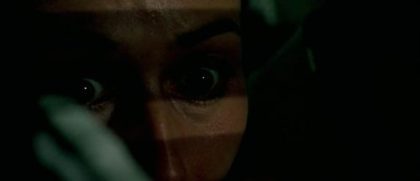
Sleepaway Camp is an interesting case, in that people who discuss the twist online only seem to focus on one aspect. When I set out to watch it, all I knew was that the killer was a trans girl. Given the year of its release (1983), I didn’t expect a particularly sensitive portrayal, but I was curious to see how the film built up to the “shocking” reveal.
It’s hard to account for hindsight bias, but to me, the plot is highly telegraphed. For one thing, the choppy editing doesn’t quite conceal the moment the little boy dodges the boat during the opening accident scene. Throughout the film, it’s obviously Angela committing the murders; no other character has nearly as much motive. The red herrings are light pink at best.
Even when you see most of the story beats coming, though, the film is still worth a watch. If you start out knowing Angela was assigned male at birth, Sleepaway Camp becomes a surprisingly nuanced queer character study—one that also happens to be a bizarre parade of blood, boobs, and butts.
Angela shows signs of selective mutism and anorexia; her behavior seems to stem from a combination of childhood trauma, gender dysphoria, and uncertain sexuality. A flashback near the end establishes Angela’s aunt as a lunatic who’s been forcing her to dress and present as female—which raises the possibility that Angela (née Peter) might not identify as a girl at all. (Of course, the sequel casually mentions a sex change operation, suggesting Angela has settled into her femininity. But she’s literally a different person at this point, being played by the Boss’s sister Pamela Springsteen instead of original star Felissa Rose.)
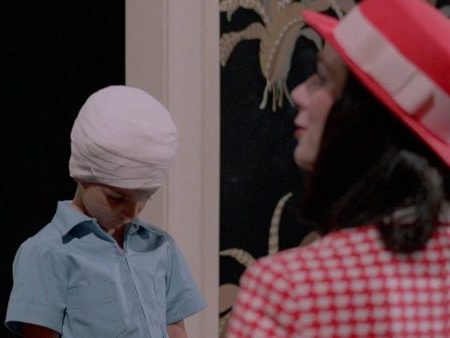
The Sixth Sense is far less graphic, yet arguably no less disturbing than the other films I’ve discussed, and its big reveal is one of the most famous in cinematic history. I had this twist spoiled by The Lonely Island’s “Jizz in My Pants,” of all things. I was in middle school when that song came out, and while I’d long since learned about the birds and the bees, I didn’t quite realize how the guys were dirtying themselves.
In any event, when I ran across that spoiler online, my first thought was, “Oh, yeah. I knew that.” See, the lyric goes, When Bruce Willis was dead at the end of Sixth Sense, not When Bruce Willis died at the end of Sixth Sense. There’s a subtle difference.
I finally sat down to watch the damn movie, and I think I get the hype now. The twist isn’t brilliant because you can’t possibly see it coming; it’s brilliant because you can, and it’s set up with just enough detail for an attentive viewer to catch. I’ll never know whether I would have figured it out on my own, but as things are, I can’t help noticing how Willis’s character’s wife only sets the table for one person. If you’re aware the protagonist is a ghost, the dramatic tension comes from waiting for him to reach the same conclusion. (I’m still not sure why the film’s ending aroused Andy Samberg, though.)
Spoilers can be frustrating, and it’s basic etiquette not to inflict them on others deliberately. However, they don’t have to deter you from checking out the works associated with them. Go ahead and watch what you want, even if you think you know what happens. You may be surprised—not by the twists themselves, but by how they enhance your viewing experience.

 Media Shower